
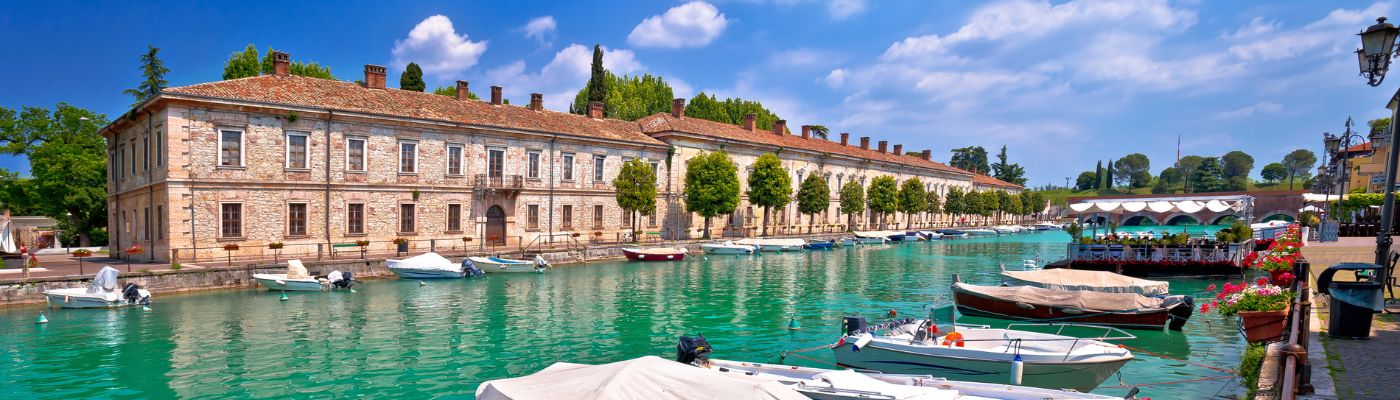
Headlines about a “half-empty” Lake Garda keep making the rounds – mostly without justification. The lake’s water level naturally fluctuates considerably over the course of the year and from year to year. It is measured at the official gauge in Peschiera del Garda, where the Mincio River leaves the lake. Anyone who reads the figures correctly quickly understands: a low level does not mean the lake is drying up.
Where and how it is measured
The official gauging station is located in Peschiera del Garda at the southeastern end of the lake. Here, a weir regulates the outflow into the Mincio; the volume of water is monitored and partially limited via the Salionze sluice gates. This means Lake Garda is not a purely natural system but is managed – within the limits of what is possible – for example to supply water for agriculture in the Po basin in summer.
What “gauge 0” really means
The key point for understanding: the gauge value “0” is an arbitrarily set reference mark slightly below the lowest values measured over many years. A gauge reading of 0 cm therefore by no means indicates that the lake is empty. At its deepest point, Lake Garda is 346 meters deep, with an average depth of around 135 meters – so fluctuations of a few dozen centimeters occur only at the surface of an enormous body of water.
Why the level fluctuates
The water level follows the seasons: in spring, snowmelt and rain cause the level to rise; in summer, it falls again due to evaporation and water withdrawal. Dry winters with little snow have a particularly strong effect. Records go back to the 1950s; from them, maximum, minimum and average values can be derived against which the current level can be assessed.
The 2023 drought – in proper perspective
In spring 2023, a winter with exceptionally little precipitation led to an unusually low level; images of exposed shorelines went around the world. Headlines about a “half-empty” lake were misleading, however: measured against the lake’s enormous volume, the decline was small. After heavy rainfall in summer 2023, the level rose significantly again, and the acute concern was over.
Why the level matters to vacationers
For trip planning, the water level usually plays only a minor role – beaches, promenades and boat services operate even when the level is lower. At extremely low levels, individual boat landings or beach areas may be affected. If you want precise information, current gauge readings are available online; background on the lake’s climate can be found on the Weather on Lake Garda page.
Frequently asked questions
Where is the water level of Lake Garda measured?
At the official gauge in Peschiera del Garda, where the Mincio leaves the lake. The outflow is regulated by a weir and the Salionze sluice gates.
Does a gauge reading of 0 cm mean the lake is empty?
No. “0” is merely a reference mark just below the long-term lowest values. Lake Garda is up to 346 meters deep – a low level affects only the surface.
Is Lake Garda short of water?
In dry years such as 2023, the level is low at times but recovers after rainfall. Headlines about a “half-empty” lake are greatly exaggerated relative to its volume.
As of: May 2026 – The level fluctuates seasonally; the current value is within the usual spring range. Up-to-date daily values are available on the relevant gauge portals.


